 Craig Pornorey
After receiving a Local Law 11 violation, a building owner should act at once. Start by reading the notice, confirming which agency issued it, and recording every deadline. Then check the property record in DOB NOW: Safety, contact a Qualified Exterior Wall Inspector (QEWI), and arrange required public protection if the façade is unsafe. Create a clear list of each administrative and physical problem and the steps needed to correct it before fines grow. Waiting can turn a routine notice into a costly problem that affects property value and daily building operations.
New York City Department of Buildings (DOB) façade rules follow fixed dates and technical requirements. Co-op boards, condo managers, and commercial landlords can benefit from professional help with Local Law 11 violations. A qualified professional can help stabilize the property, limit fines, and guide the building through the city’s inspection and filing process.
What Should Owners Do Immediately After Receiving the Violation?
The first hours and days after receiving a Local Law 11 violation can determine whether the work stays organized or becomes a larger problem involving several city agencies. Some boards and landlords ignore the notice while looking for old records. Others approve quick repairs without the right permits. Both responses can make the situation worse. A calm and organized plan helps limit danger, cost, and liability.
Building leaders should form a project team right away. It may include the property manager, building staff, engineering consultants, and, if needed, legal counsel. Each action taken after the paper notice arrives or the electronic alert appears should be recorded. Those records may later support an administrative challenge, an insurance claim, or a request for more time.
Read the Notice and Record Every Deadline
Read the notice line by line. Focus on the legal dates, not just the short description of the problem. The notice should list the issue date, the appearance or response date, and the period allowed to correct the problem. Property managers should place each date on a shared calendar right away. DOB deadlines continue during board meetings, weekends, and holidays unless the agency states otherwise.
Pay close attention to the 30-day challenge period under 1 RCNY §103-04. An owner who wants to dispute the penalty generally must act within that period. Missing it can remove the owner’s right to challenge the violation through the issuing unit. The building may then remain responsible for the fine even if the city made a clerical or administrative mistake.
Verify the Violation in DOB NOW or the NYC Department of Buildings Records
Do not depend only on a paper notice sent by certified mail. Mail can arrive late or go to the wrong person. Management should sign in to DOB NOW: Safety and the Buildings Information System (BIS). Search the record using the property’s Building Identification Number (BIN). This can show whether the matter is a FISP filing issue or an OATH/ECB summons that requires a hearing.
The online record may also show whether the new violation stands alone or is part of a longer series of problems. An unresolved administrative issue can lead to another DOB inspection. That inspection may produce added building code or environmental violations that need to be handled at the same time.
Identify the Violation Number, Condition, Location, and Required Remedy
Each notice contains details that define the work. Owners should record the violation number, the building elevation involved, and the exact feature named by the inspector. The location may be the north or south wall, a courtyard, or a lightwell. The affected feature may be cracked terra cotta, a rusted fire escape, or a brick parapet that is moving outward.
Owners also need to identify the remedy required by the agency. Some notices ask only for a missing FISP 1 report. Others require immediate pedestrian protection under an emergency declaration. Knowing whether the next step is an engineering filing or steel protection over the sidewalk helps the owner direct money and staff where they are needed first.
Notify the Managing Agent, Board, Insurer, and Relevant Stakeholders
Open communication matters when a city violation affects a residential or commercial property. At a co-op or condominium, the board should meet to review the risk, approve spending, and plan communications. The managing agent may need to notify residents if a balcony, terrace, or other area must be closed because of a safety concern.
Ownership should also review its commercial property and general liability insurance. If the violation involves a dangerous condition that could cause a fall or falling-object injury, prompt notice to the insurer may be required. Failing to report the matter on time could create problems with coverage if an accident happens during the repair work.
Hire a Qualified Exterior Wall Inspector Before Authorizing Repairs
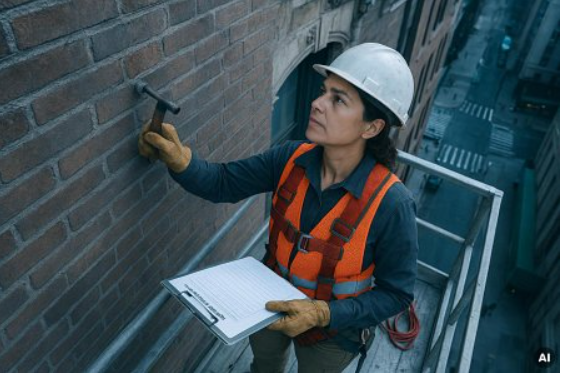
A common mistake is to call a general masonry contractor and ask the contractor to patch the area named in the notice. That work alone will not remove a Local Law 11 violation. The DOB requires the inspection, repair plan, and certification to be directed by a QEWI. The QEWI must be a New York State licensed Professional Engineer (PE) or Registered Architect (RA).
The QEWI acts as the building’s technical representative and contact with the DOB. Before exterior work begins, the QEWI should inspect the façade, prepare the repair scope, make the required filings, and oversee the work. This process helps the repairs meet 1 RCNY §103-04 and gives the owner a clear record of what was done.
Preserve Inspection Reports, Photographs, Notices, and Correspondence
A strong response depends on a clear record of compliance. The property manager should create one central file for all exterior wall documents. It should include earlier FISP filings, contractor bids, permit applications, photographs with dates, and proof of every message sent to or received from city agencies.
If the building later appears before OATH or asks the DOB Commissioner to reduce or waive a penalty, these records can show that the owner acted in good faith and took reasonable steps. Without dated proof, an owner may have difficulty explaining a delay or challenging the highest possible fine.
What Are the Risks of Ignoring a Local Law 11 Violation?
Viewing a DOB violation as a minor paperwork issue can be very expensive. Local Law 11 matters involve public safety under New York City law. The enforcement system is set up to make long periods of non-compliance costly.
An open façade violation can also affect many parts of the property’s finances and operations. It may limit leasing, complicate financing, and increase the owner’s exposure in a personal injury or property damage lawsuit.
Daily or Escalating Civil Penalties
FISP fines can continue to grow. An unresolved unsafe condition carries a base fine of $1,000 per month during the first year. If the issue remains open in later years, the city can add sidewalk-shed charges based on the number of linear feet. The charge is $10 per linear foot each month in year two, $20 in year three, $30 in year four, and $40 in year five.
For a building with 200 linear feet of sidewalk shed, the year-three shed charge is $4,000 per month in addition to the base fines. Recent laws, including Local Laws 48 and 51 of 2025, also target repairs that remain stalled. They add possible penalties of $5,000 to $20,000 for missing key repair milestones, along with separate public right-of-way charges.
Increased Liability for Injuries, Falling Materials, and Property Damage
An open façade violation creates serious lawsuit risk in New York. If brick, stone, or metal trim falls and injures someone, the injured person’s lawyer can use the open DOB violation to show that the owner had notice of the danger. Claims may go beyond the owner’s insurance limits and may expose boards and owners to punitive damages.
Falling materials can also damage cars, lower-level skylights, and nearby roof systems. Once the city has warned an owner that the walls are unsafe, failing to act makes it much harder to defend a later injury or property damage claim.
Insurance, Refinancing, Sale, and Property-Value Complications
Lenders and title insurance companies often review current city violation records before approving a loan or property sale. An open FISP violation, especially a FISPHAZ condition or hazardous OATH summons, can delay refinancing, loan changes, and closings. Lenders may refuse to release escrow money or approve a loan while the property has an unresolved dangerous condition.
Insurance companies may also check DOB records before issuing or renewing a policy. An insurer could give the owner 30 to 60 days to fix the violation, raise the premium, or remove coverage for exterior wall liability. The owner may then have to buy coverage in a surplus-lines market, where premiums and deductibles are much higher.
Difficulty Obtaining Permits or Closing Future FISP Filings
The DOB may restrict new work permits while serious violations remain open. If the owner wants to renovate a lobby, replace boilers, or build out tenant space, an unresolved hazardous façade matter can lead the agency to hold related permits for the property.
An old violation can also block later FISP filings. A building may not be able to close Cycle 10 while hazardous violations from Cycle 8 or Cycle 9 remain open. This creates a backlog in which older problems interfere with new filings and allow additional fines to continue.
What Should Owners Do When the Façade Is Classified as Unsafe?
An “Unsafe” rating leaves little time for long-term planning. It means that part of the building envelope presents an immediate or likely danger to the public. The owner must take protective action right away and then complete the permanent repairs within the required period.
The owner must handle both the physical danger and the city filings. Following the required schedule can help prevent the city from hiring emergency contractors. Those contractors may install protection or perform work at high municipal rates, with the cost placed as a lien on the property.
Secure the Hazardous Area and Protect Residents, Pedestrians, and Neighboring Property
The first day should focus on making the site safe. Building staff and security should block off the area below the unsafe wall with barriers, caution tape, and clear signs. If the area extends over a courtyard, playground, garage entrance, or roof terrace, close that space to residents and visitors.
Management should give clear instructions to people living below the unsafe area. Until protective structures are installed, residents should not open windows, use outside balconies, or operate air conditioners located under the possible path of falling material.
Install a Sidewalk Shed, Safety Netting, or Other Required Public Protection
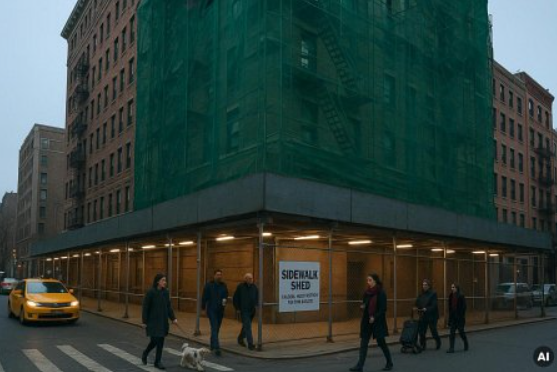
New York City rules require public protection as soon as an unsafe exterior condition is found. The usual method is a heavy sidewalk shed along the affected street frontage. Where required, it should extend 20 feet beyond each side of the property line. If a full shed cannot be used, or if the unsafe area is in a courtyard, approved options may include structural safety netting or heavy timber catch platforms.
These protective systems need DOB permits. In an emergency, a licensed contractor such as Nova Construction Services may start installing sidewalk protection before the regular review is complete, but an emergency work permit filing must be submitted to the DOB within two business days. An unsafe façade should not remain open over a public walkway while the owner waits for a normal permit review.
Arrange an Emergency Investigation by a QEWI or Qualified Design Professional
After temporary protection is in place, the QEWI should perform a close investigation of the affected area. This requires more than looking from the street with binoculars. The engineer may need suspended scaffolding, an aerial lift, or industrial rope access to inspect the wall by hand.
The QEWI must find the cause of the failure. Possible causes include rusted shelf angles that push masonry outward, broken terra cotta anchors, or weak parapet mortar. Finding the source helps define the full danger area and the permanent repair needed.
Develop Repair Plans and Obtain Required Permits
An unsafe façade needs an engineering scope and construction drawings. The QEWI or a structural engineering firm should prepare plans showing brick replacement, lintel repairs, pinning systems, structural tuckpointing, and waterproofing details.
Submit the plans to the DOB to obtain the needed construction permits, such as Alteration Type filings. If the building is an individual landmark or is in a historic district, submit the drawings to the Landmarks Preservation Commission (LPC) as well. The LPC review checks that replacement materials, mortar colors, and joint details match the historic building.
Meet the Repair, Safety-Measure, and Amended-Report Deadlines in the Notice
The repair schedule for an unsafe façade is strict. Under standard DOB rules, the owner has 90 days from the filing of the unsafe technical report to complete the physical repairs. If the work cannot reasonably finish within that time, the QEWI must submit a FISP extension request before the 90 days end.
An extension requires a $305 filing fee. The application must include a signed construction contract, a detailed schedule, permit filings, and proof that public protection remains in place. The city does not accept lack of money as a reason for an extension. The owner must show steady work on the project. Extensions are usually granted in 90-day periods.
Escalating Penalties for an Uncorrected Unsafe Condition
Missing the 90-day repair period or failing to request an extension can lead to automatic monthly fines. The charges start at $1,000 per month and continue until the DOB receives and accepts an amended report showing that the unsafe conditions have been corrected.
Under the city’s “Get Sheds Down” enforcement program, a building can also face growing linear-foot charges if its sidewalk shed stays up without proof of active construction. In serious cases, New York City may bring a case under the Nuisance Abatement Law. The city can seek civil penalties of up to $1,000 per building per day and may pursue a receiver for long-term non-compliance.
How Can Owners Correct a Local Law 11 Violation?
Correcting a Local Law 11 violation requires an organized repair process led by the QEWI. Unlicensed workers, incomplete repairs, and missing records can cause the amended report to be rejected and leave the violation open.
To close the matter, ownership must coordinate the engineer’s design, the contractor’s work, and the city’s approvals. Record every stage so that the filing satisfies the review standards used by DOB Plan Examiners in DOB NOW: Safety.
Obtain a Written Scope of Work From the QEWI
The process starts with a written scope prepared for the property. It turns the inspection findings into instructions that contractors can price and follow. The scope should list repair locations, demolition methods, mortar requirements, flashing details, and steel preparation procedures.
It must cover every item in the original violation and any defect that caused the problem. If the scope misses one cracked lintel or damaged balcony edge listed in the DOB report, the department may reject the final amended filing.
Separate Emergency Stabilization From Permanent Façade Repairs
Plan temporary stabilization and final repairs as two separate steps. For an unsafe condition, the first step is to remove the immediate danger. This may involve removing loose concrete, securing loose parapet stones, or putting structural netting over cracked masonry.
Temporary work protects people below and gives the team time to plan the full repair. It does not close the violation. Patches and netting alone are not a final correction. The owner still needs permitted permanent work and an accepted amended report.
Select Licensed Contractors and Verify Insurance Coverage
High-rise exterior repairs require contractors with specialized experience. Owners should seek bids from firms that have performed New York City masonry restoration, hold the needed DOB Special Rigger or General Contractor licenses, and have a good safety record.
Before signing a contract, verify the contractor’s license and safety history through the DOB online registry. Open safety violations or stop-work orders connected to the contractor can delay or prevent permit approval for the building.
Resolve Permits, Sidewalk Sheds, Scaffolding, and Street-Use Requirements
No physical work should begin until the required city permits are in place. Working with the filing engineer, the contractor must obtain permits for supported pipe scaffolding, suspended stages, and the masonry repair itself.
If materials or a sidewalk shed will occupy the public sidewalk, the project also needs coordination with the NYC Department of Transportation (DOT). Under updated sidewalk-shed rules, permits usually last 90 days and require proof that work is moving forward. The contractor should keep a weekly site log showing daily trade activity to support renewals and avoid right-of-way charges.
Complete Repairs and Obtain the Required Sign-off or Amended FISP Filing
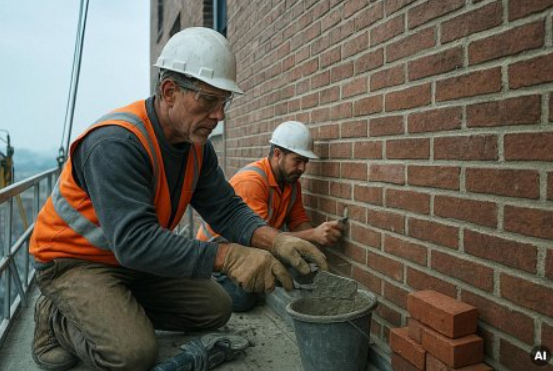
While the contractor completes the scope, the QEWI should perform regular special inspections. These checks confirm that the materials and installation follow the approved design. After the final brick is installed, the mortar joints are finished, and the lintels are painted, the QEWI should inspect every repaired elevation and prepare a punch list.
After the technical review, the contractor and engineer must obtain sign-offs for all open construction permits from the local borough DOB office. Once the permits are signed off, the QEWI can prepare the amended technical report and submit it through DOB NOW.
Can a Building Owner Challenge a Local Law 11 Violation?
Some DOB violations contain factual or administrative errors. With many properties tracked through automated systems, mistakes can include wrong parcel numbers, clerical errors, and fines assessed before the city reviews a timely filing. Owners may have legal ways to challenge a citation or ask for a waiver.
A challenge must follow the city’s administrative rules. An angry conversation at an OATH hearing or an informal letter to the DOB Commissioner will not resolve the case. A useful challenge needs a technical review, clear evidence, and knowledge of the applicable hearing process.
When To Ask the QEWI To Review an Inaccurate or Incomplete Notice
If a notice says that the building is unsafe or missed a filing when the facts suggest otherwise, send it to the QEWI immediately. The engineer should compare the notice with the property’s filing history, approved plans, and current field conditions.
A technical challenge may be appropriate if the inspector listed a feature that belongs to a neighboring property, such as a party-wall parapet, or if the automated system says a report was missing even though it was submitted and accepted on time. The QEWI can prepare a stamped response explaining the factual error.
How To Correct an Administrative or Filing Error
Administrative mistakes often come from incorrect information in DOB NOW: Safety. For example, a report may have been filed on time under the correct BIN but sent to the wrong internal queue. An owner may also receive a late fee because the system used the wrong tax-block sub-cycle.
For a non-physical error, the owner or filing representative should send an administrative inquiry to the DOB Façade Compliance Unit. Include filing receipts, dated electronic confirmations, and tax-map records. Clear proof may allow the agency to fix the database and remove the fine without a lawsuit.
When To Request a Hearing or Contest a Penalty
If an OATH/ECB summons carries a large civil penalty, the owner has the right to contest it at an administrative hearing. A challenge may make sense if the building can prove timely compliance, show that it was exempt from FISP, or identify a problem with how the notice was served. One possible exemption is a building under seven stories.
Under 1 RCNY §103-04, an owner disputing a FISP civil penalty must send written proof to the issuing unit within 30 days after service. The proof may show a timely filing, an approved extension, or a full demolition sign-off issued before the relevant cycle. Missing the 30-day period can prevent the owner from challenging the penalty.
When Construction Counsel or an Administrative-Law Attorney Should Become Involved
Bring in an attorney who handles New York City construction and administrative law when fines reach five or six figures or when the violation could stop a refinance or sale. Counsel can address the NYC Administrative Code, OATH procedures, and Article 78 court appeals.
An attorney can also help request a waiver under a legal exception. If the property changed hands through a recent arm’s-length sale, foreclosure, or bankruptcy reorganization, counsel may seek a “New Owner Waiver” under 1 RCNY §103-04. The waiver can remove older civil penalties caused by a previous owner and save the new owner tens of thousands of dollars.

Emerging Façade Policy and Long-Term Asset Strategy
New York City’s approach to exterior wall maintenance continues to move toward greater use of data and tracking. Groups such as Thornton Tomasetti and city agencies have reviewed Local Law 11 and are studying the balance between pedestrian safety and the cost of long-term sidewalk sheds. Plans such as “Get Sheds Down” and changes introduced by Local Law 49 of 2025 point to a system in which lower-risk buildings may have inspection periods of 6 to 12 years. At the same time, the city may apply stronger penalties to owners who delay repairs without good reason.
Property managers should also review tools such as drone thermal scans, ultrasonic testing that does not damage the wall, and sensors that monitor façade movement. Current rules still call for close, hands-on inspections by licensed professionals. However, these tools can help boards track conditions between inspection cycles and spot problems earlier. Treating façade care as a regular part of property planning, rather than an occasional city problem, helps protect the building’s structure, legal record, and appearance for many years.