 Mylarith Qynthoril
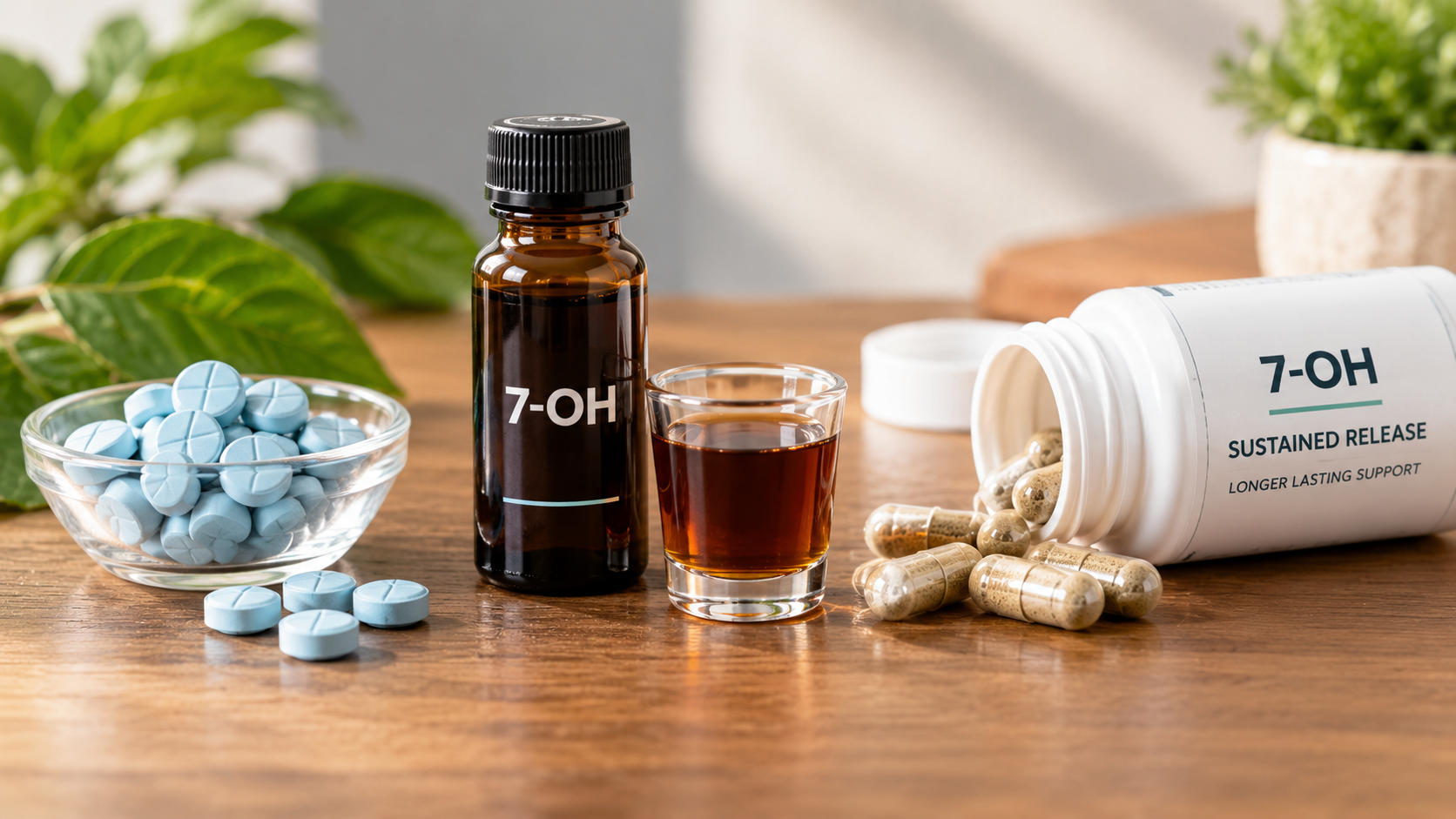
Walk into any shop that carries kratom alkaloid products, or scroll through an online retailer, and the variety of formats is the first thing you notice. Chewable 7-oh tablets make up most of the listings, but liquid shots, "sustained formula" tablets, capsules and powders all sit alongside them. Each format states its contents differently, and that is where most labeling confusion begins. This guide explains how the main formats are packaged and labeled, what the numbers on each one actually mean, and which details are worth checking regardless of the format in front of you.
Why Format Matters When Reading a Label
The same alkaloid can be sold in very different packages. One product might list an amount per tablet, another an amount per bottle, and a third an amount of extract rather than an amount of any single compound. None of these is wrong, but they are not directly comparable unless you do the arithmetic.
Format also affects how a product is meant to be portioned. Some tablets are scored to be split. Some bottles hold more than one serving. Some labels define a serving clearly and others leave it to the reader. Knowing the conventions for each format makes it much easier to understand what you are looking at.
Chewable Tablets
Chewable tablets are the most common format on the market. They are typically sold in blister cards, small bottles or bulk boxes, and the label usually gives two figures: the amount per tablet and the total per pack.
The range of strengths is wide. A single brand can offer tablets at several different per-tablet amounts. 7Stax, for example, lists tablets from 20mg to 150mg of 7-OH per tablet across its range, with pack sizes from four tablets to fifteen. Opia lists 30mg per tablet on one of its four-count cards, with each tablet scored to split into two 15mg halves.
A few things are worth checking on any tablet label:
• Per-tablet amount versus pack total. A pack labeled 500mg might hold five tablets of 100mg or ten tablets of 50mg.
• Scoring. A score line, or a cross score that divides the tablet into quarters, usually indicates that the manufacturer defines a serving as less than a whole tablet.
• Flavor-specific lab reports. Many brands publish a separate certificate of analysis for each flavor, since flavors may be produced in separate batches.
Liquid Shots
Shots are small bottles of liquid extract. They come pre-measured, but "pre-measured" does not always mean "one serving."
Bottle sizes and concentrations vary a great deal. Sevn's Mini shot, for instance, holds 25mg of 7-OH in a 2 fl oz (60mL) bottle and is sold as a single-serve bottle. It uses a push-button cap that keeps the extract separate from the liquid until it is pressed. Kradose, by contrast, lists 300mg of 7-hydroxymitragynine extract in a 15ml bottle, and the product description says it is intended for small measured portions rather than a single serving.
Those two products illustrate why the bottle alone tells you very little. Before comparing any 7-oh shot with another, check the total amount per bottle, the bottle volume, and whether the label defines the whole bottle or only part of it as a serving. A 7-oh shot collection on a retailer site will usually list the total milligrams in each product title, with bottle size and serving details in the description.
"Sustained" and "Rapid Release" Tablets
Some brands use names that describe how their tablets are formulated, such as "sustained formula," "rapid release" or "extended." These are brand descriptions. The FDA has not evaluated these products, so release claims on packaging should be read as marketing language rather than verified performance data.
The more useful information is usually printed in smaller type. The 7ohmz range is a good example of how much variation can sit within one brand. Its Sustained Formula tablets list 28mg of 7-OH per tablet and state one serving per tablet on the label, with cross scoring for smaller pieces. Its Maxxx Strength tablets list 77mg per tablet, are divided into four equal servings, and are described as for advanced users only. The brand name is the same, but the per-tablet amounts and serving definitions are very different.
When you see a release claim, look past it to three facts: the amount per tablet, the label's definition of a serving, and the batch lab report.
Capsules and Powders
Capsules are less common for 7-OH than tablets, but they are also used for some kratom leaf and mitragynine (MIT) products. Capsule labels generally list the amount per capsule and the number of capsules per pack. As with extract tablets, a capsule containing a given weight of leaf or extract does not contain that weight of any single alkaloid.
Powders are the hardest format to portion accurately, because the amount depends entirely on how it is measured. Labels may state the total weight and the alkaloid content per gram. Anyone comparing a powder with a tablet or shot needs to convert both to the same unit first.
A Format-Neutral Checklist
Whatever the format, the same questions apply:
1. What is the amount per unit? Per tablet, per bottle, per capsule or per gram.
2. How does the label define a serving? One tablet, a quarter tablet, a portion of a bottle?
3. What is the total per pack? Useful for comparing packs, but easy to confuse with the per-unit figure.
4. Is the amount for a specific alkaloid or for an extract? "300mg extract" and "300mg 7-OH" mean very different things.
5. Is there a current certificate of analysis? It should match the batch number on the packaging and come from an independent lab.
6. Is the packaging child-resistant and clearly labeled for adults? Many products look like candy, so storage matters.
7. Is the product legal where you live? Format does not change legal status.
Common Labeling Mistakes
The same misunderstandings come up again and again:
• Reading the pack total as the per-tablet amount. This is the most common error, especially with high-count packs.
• Assuming a shot bottle is one serving. Some are, many are not.
• Treating extract weight as alkaloid weight. The lab report is the only way to see the alkaloid content of an extract.
• Assuming all flavors are identical. Different flavors can come from different batches with different test results.
• Comparing products in different units. Convert everything to milligrams per unit before drawing any conclusion.
Format Does Not Change Legal Status
It is easy to assume that some formats are treated differently by the law, but that is not how scheduling works. As of early October 2026, the DEA had published a notice of intent to temporarily schedule 7-OH above a specified threshold, and no final order had been issued. If an order is published, it would apply to covered 7-OH regardless of whether it comes as a tablet, a shot or a capsule. State and local laws also apply to the substance, not the shape of the package.
Storage and Shelf Life
Every format has its own storage considerations. Tablets in blister cards stay sealed until each one is pushed out, which helps protect them from moisture. Bottled tablets are exposed each time the bottle is opened, so the cap should be closed firmly. Shots should be kept upright and away from heat, and powders should be stored in airtight containers away from humidity. Whatever the format, check for a manufacturing or expiry date on the packaging, and keep the product in its original labeled container so its strength can always be identified.