 Mylarith Qynthoril
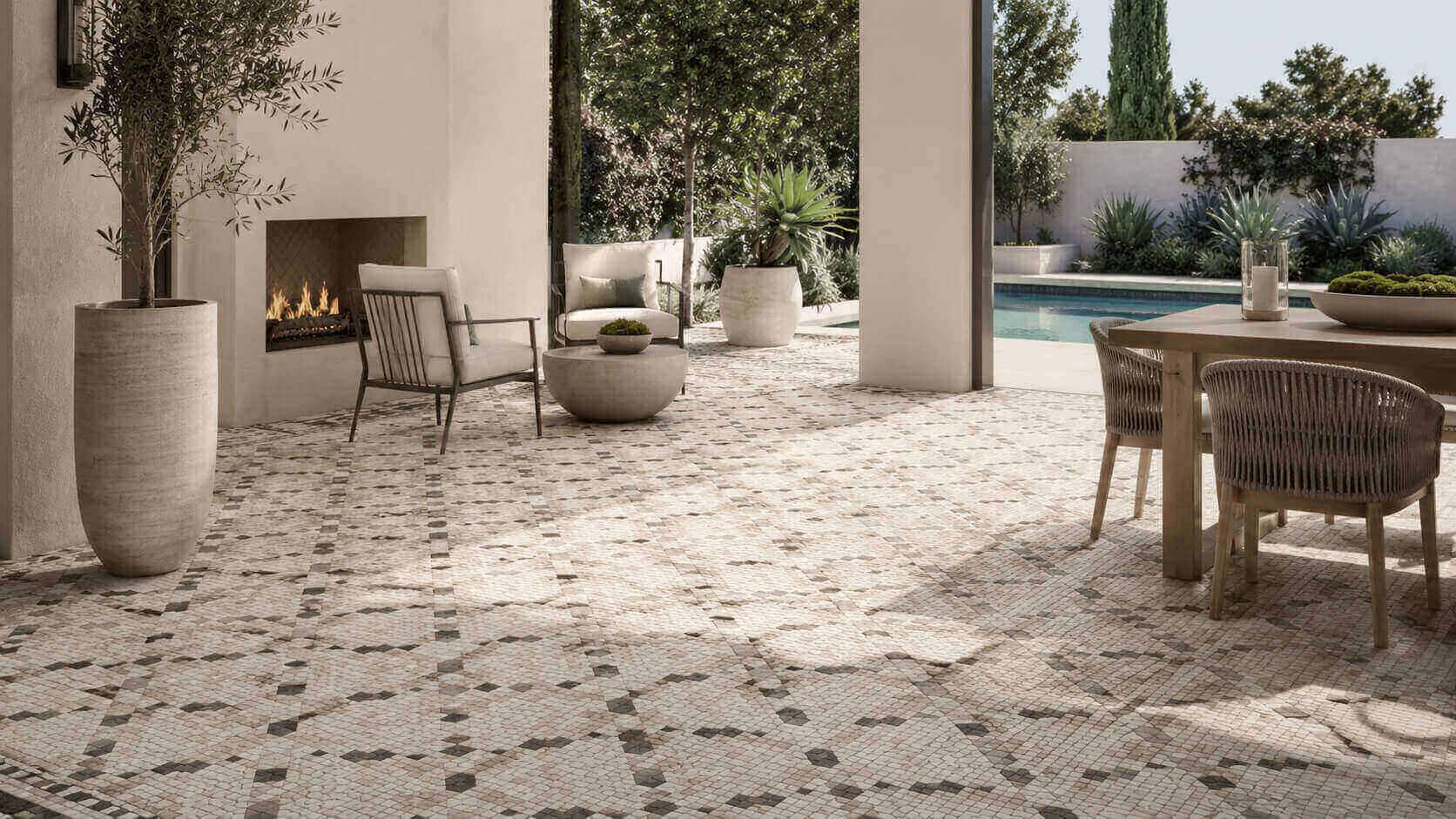
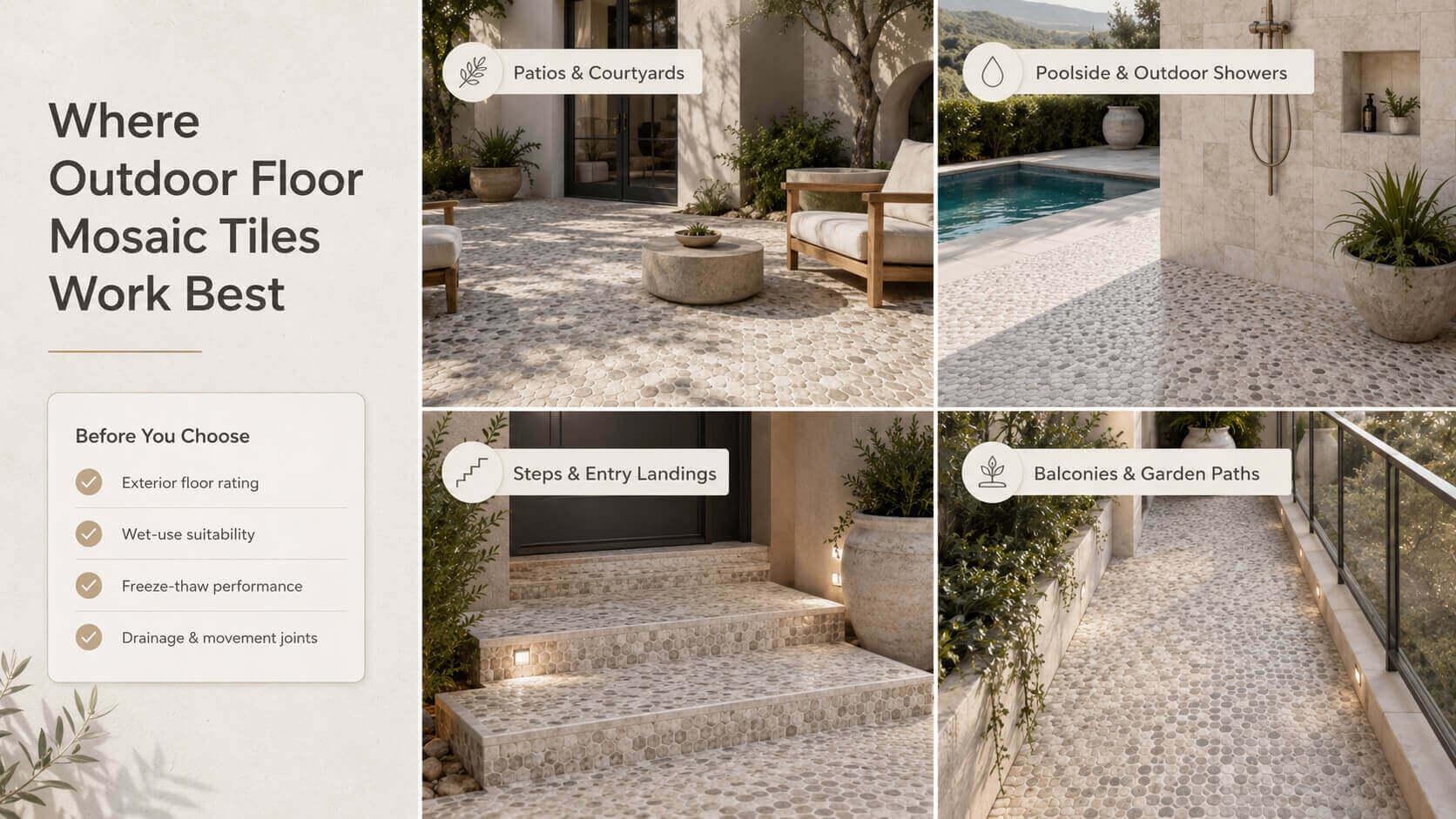
Outdoor floor mosaic tiles work best where small-format tile provides a functional or visual advantage: patios and courtyards, pool-adjacent surfaces, outdoor showers, steps and entrances, balconies, garden paths, and carefully designed outdoor kitchen areas. The important qualification is that the exact tile—not simply the material category—must be approved for its intended exterior, floor, wet, freeze-thaw, or submerged application.
Porcelain mosaic is often a practical starting point for exposed outdoor flooring because industry standards define porcelain tile as having water absorption of 0.5% or less when tested according to ASTM C373. Low absorption reduces the amount of water available inside the tile body during cold-weather exposure, although low absorption by itself does not guarantee the success of an exterior installation.
Solidshape explains where outdoor floor mosaic tiles can be used to add detail and character to exterior spaces.
What Are Outdoor Floor Mosaic Tiles, and Why Are They Popular?
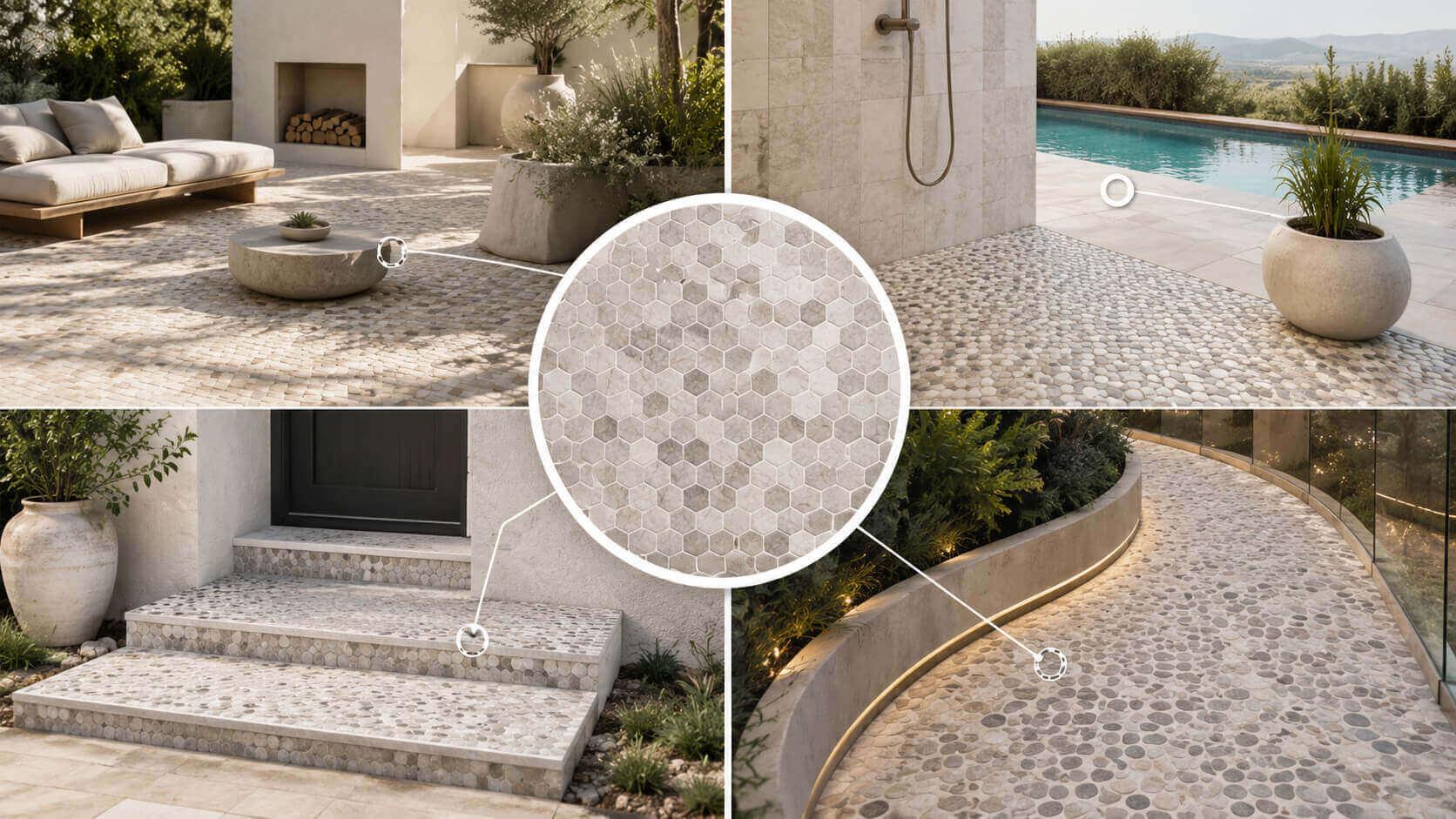
Outdoor floor mosaics consist of numerous small tile pieces arranged individually or, more commonly, mounted on sheets for easier installation. The traditional ANSI definition of ceramic mosaic tile describes pieces with a facial area of less than 9 square inches, commonly about 1/4 to 3/8 inch thick, although actual dimensions and thicknesses vary considerably by material and manufacturer.
Their outdoor appeal comes partly from geometry. Small pieces can follow curves, transition toward drains, wrap stair details, create borders, and fit irregular areas with fewer difficult cuts than large-format tile.
More grout joints can also provide additional surface texture, but grout density should never be treated as proof that a mosaic is safe for wet exterior use. TCNA specifically notes that mosaic and highly structured surfaces can complicate DCOF testing, making manufacturer-declared use classification particularly important.
What Are the Main Benefits of Outdoor Floor Mosaic Tiles?
- Design flexibility: Small mosaic pieces adapt well to curved edges, steps, drains, borders, compact patios, and irregular architectural conditions where large tiles would require extensive cutting.
- Low-absorption options: Porcelain tile is defined by ANSI as having water absorption of 0.5% or less, which makes it a useful material category to investigate for moisture-exposed environments.
- Wet-area specification: ANSI A326.3 includes an Exterior Wet category. Industry guidance summarizing the standard commonly references a wet DCOF of approximately 0.55 for EW conditions where applicable, but TCNA stresses that friction data cannot be the sole basis for judging slip performance.
- Freeze-thaw evaluation: ASTM C1026-23 provides a standardized method for testing ceramic and glass tile resistance to repeated freezing and thawing and is specifically relevant when evaluating tiles for outdoor service.
- Long service potential: TCNA’s North American ceramic-tile environmental product declaration uses a 75-year reference service life under its stated installation and building assumptions. That figure is a life-cycle modeling assumption rather than a warranty, but it illustrates the long-service potential of a correctly designed tile assembly.
Where Do Outdoor Floor Mosaic Tiles Work Best?
The strongest applications include small patios and courtyards, pool surrounds, outdoor showers, entry landings, exterior steps, balconies, and curved or irregular zones. Mosaic is particularly useful where large-format tile would create excessive cutting or where borders and patterns need to define a functional area.
Pool and shower environments are logical applications only when the tile is explicitly approved for the relevant condition. A tile suitable for a decorative exterior wall, for example, should not automatically be assumed suitable for an exposed pool deck or shower floor.
Outdoor mosaics are not recommended simply because they are labeled porcelain, stone, or glass. Avoid wall-only mosaics on walking surfaces, polished products without appropriate wet-use suitability in exposed walking areas, and products without verified freeze-thaw performance where saturation and freezing are realistic.
Vehicle-loaded surfaces also require assemblies engineered for their structural loading rather than ordinary pedestrian mosaic installations. Exterior tile additionally needs movement accommodation: TCNA guidance states that movement joints are required in tile installations and that exterior applications must account for temperature-related dimensional movement.
Which Outdoor Mosaic Design Styles Work Best?
Modern Geometric
Hexagons, small squares, linear mosaics, and monochromatic stone-look combinations work particularly well in contemporary courtyards and compact patios. Repetition creates visual texture while allowing the architecture, furniture, and planting to remain dominant.
Mediterranean and Courtyard
Warm stone tones, blues, patterned geometry, and decorative borders suit courtyards, fountains, stair risers, and landscaped terraces. Using mosaics selectively around a perimeter or focal area can create stronger architectural definition than covering an entire large patio.
Resort and Poolside
Blue, green, white, and glass-accent mosaics can visually connect swimming pools with surrounding water-oriented spaces. ANSI A137.2 establishes performance requirements for glass tile covering characteristics such as mounting, strength, dimensional properties, and thermal shock, so product approval for the intended pool or exterior application matters more than appearance alone.
Organic Natural Stone
Pebble, travertine, slate, limestone, and marble mosaics can create softer transitions between architecture and landscaping. Unlike standardized porcelain classifications, natural-stone performance varies by geological material. The Natural Stone Institute therefore provides testing for characteristics including absorption, density, abrasion, flexural strength, compressive strength, DCOF, and freeze-thaw durability.
Outdoor Mosaic Tile Selection Checklist
- Confirm approval for the exact application: exterior floor, wet floor, submerged pool area, stair, balcony, or wall.
- For exposed wet walking surfaces, look for an ANSI A326.3 EW—Exterior, Wet manufacturer declaration and evaluate drainage, contaminants, traffic, and cleaning conditions as well.
- In freezing climates, request appropriate freeze-thaw performance data such as ASTM C1026 for ceramic or glass tile.
- Verify water absorption. Porcelain is defined at 0.5% or less, while natural-stone absorption must be assessed for the specific stone.
- Evaluate backing, mortar, grout, waterproofing, drainage slope, substrate, and movement joints as one complete assembly.
- Account for increased labor where intricate sheet alignment, pattern matching, curves, or extensive cutting are required.
- View and wet a physical sample outdoors before approving color, reflectivity, surface texture, and visual variation.
How Do Outdoor Floor Mosaics Compare With Alternatives?
|
Material/Option |
Appearance |
Durability with data |
Maintenance |
Cost range |
Best use case |
|
Outdoor floor mosaic tile |
Highest pattern and detail potential |
Material-dependent; porcelain versions have ≤0.5% absorption; verify EW and freeze-thaw suitability |
More joints to maintain |
About $19.81–$32.61/sq. ft. installed |
Curves, borders, wet-area detailing |
|
Large-format outdoor porcelain |
Clean, continuous appearance |
Porcelain has ≤0.5% absorption |
Low; fewer grout joints |
Roughly $10–$30 installed |
Broad patios with simple geometry |
|
2 cm porcelain pavers |
Large-scale architectural look |
Dense porcelain; structural suitability remains product-specific |
Low |
Roughly $12–$35 installed |
Patios, terraces and suitable pedestal systems |
|
Concrete pavers |
Wide range of colors and shapes |
ASTM C936 specifies ≥8,000 psi average compressive strength and ≤5% average water absorption for compliant units |
Joint and sand upkeep |
Roughly $10–$40 installed |
Large patios and walkways |
|
Natural stone pavers |
Unique organic variation |
Performance depends on stone; ASTM testing is available for absorption, strength and abrasion |
Stone-specific cleaning and possible sealing |
Roughly $10–$25+ installed |
Premium landscape-led designs |
|
Clay brick pavers |
Traditional warm appearance |
ASTM C902 Class SX requirements include 8,000 psi average compressive strength and maximum 8% average 24-hour water absorption |
Joint and stain maintenance |
About $10–$17 installed |
Traditional courtyards and paths |
These are U.S. planning ranges rather than project quotations. Homewyse’s May 2026 model places mosaic installation at approximately $19.81–$32.61 per square foot, while current outdoor-tile and paving cost guides show that material, region, substrate condition, demolition, layout complexity, and labor can change the final cost substantially.
How Should Outdoor Mosaic Tile Be Maintained, and How Long Can It Last?
Regular maintenance should begin with removing abrasive grit, leaves, and organic debris before heavier cleaning. Cleaners must be compatible with the material rather than selected only for cleaning strength.
For natural stone, the Natural Stone Institute recommends neutral stone cleaners or mild soap and warns that acidic products can etch calcareous stones such as limestone and marble. It also notes that sealing is not universally necessary and that sealing schedules should follow the specific stone, exposure, and sealer manufacturer’s recommendations rather than an arbitrary annual interval.
Ceramic tile can have very long service potential, but the 75-year reference service life used in TCNA life-cycle modeling should not be interpreted as a guaranteed outdoor lifespan. Drainage, substrate stability, freeze-thaw exposure, movement accommodation, installation quality, and compatible setting materials can ultimately determine whether an exterior mosaic assembly performs for decades or fails prematurely.
What Common Mistakes Cause Outdoor Mosaic Problems?
Common mistakes include choosing color before checking use classification, assuming every porcelain mosaic is automatically appropriate when wet, installing wall-only mosaics on floors, overlooking freeze-thaw exposure, using incompatible setting materials, ignoring drainage, and omitting required movement joints.
Another mistake is covering a very large patio entirely in detailed mosaic when the design objective could be achieved with a mosaic border, transition, or focal zone. Selective placement can preserve the visual character of mosaic while reducing grout area, installation complexity, and labor cost.
Are Outdoor Floor Mosaic Tiles Worth It?
Outdoor mosaics are worth the investment when their small format solves a genuine functional or architectural problem. Curved pool edges, showers, stair details, intricate borders, compact courtyards, and irregular transitions are situations where mosaics can provide advantages that large-format tile cannot easily reproduce.
They are less compelling when the objective is simply to cover a large, uncomplicated terrace as economically as possible. With Homewyse’s May 2026 national model estimating professional mosaic installation at roughly $19.81–$32.61 per square foot, large-format porcelain or pavers may offer better cost efficiency for expansive areas.
The best value therefore comes from matching mosaic to the location rather than assuming more mosaic automatically produces a better outdoor design.
FAQ
Can Mosaic Tile Be Used Outdoors?
Yes, provided the exact tile, backing, setting system, and substrate are approved for the specific exterior exposure and intended floor or wall application.
What Is the Best Mosaic Material for an Outdoor Floor?
Exterior-rated porcelain is often one of the most straightforward options because ANSI defines porcelain as having water absorption of 0.5% or less. Wet-use and freeze-thaw suitability must still be verified independently.
Are Mosaic Tiles Slippery When Wet?
They can be. For exposed wet floors, prioritize an ANSI A326.3 Exterior Wet manufacturer declaration and assess drainage, contaminants, texture, maintenance, and actual use rather than assuming grout lines alone make the surface slip resistant.
Can Mosaic Tile Be Used on a Patio?
Yes. It is particularly effective for small patios, courtyards, borders, transitions, and accent areas when the product is rated for exterior floor use.
Can Glass Mosaic Tile Be Used Outside?
Some glass mosaics can be used outdoors or in pools, but suitability is product-specific. ANSI A137.2 establishes performance requirements for glass tile, while the manufacturer should confirm whether the particular product is appropriate for the planned exposure.
Do Outdoor Mosaic Tiles Need Sealing?
Porcelain itself generally does not require a penetrating stone sealer, while natural stone and some grout installations may benefit from suitable sealing. The Natural Stone Institute recommends making the decision according to the stone and sealer manufacturer’s guidance rather than assuming all stone needs identical treatment.
Can Outdoor Mosaic Tile Survive Freezing Weather?
It can when the product and complete assembly are suitable for freeze-thaw exposure. ASTM C1026-23 is the relevant standardized freeze-thaw test method for ceramic and glass tile used when evaluating suitability for outdoor service.
Is Mosaic Better Than Large-Format Tile Outdoors?
Not universally. Mosaic is generally more useful for curves, intricate detailing, compact spaces, transitions, and certain wet-area layouts, while large-format exterior porcelain is often more efficient on broad patios where fewer joints and simpler maintenance are priorities.